
Connecting a meter to the internet does not guarantee trustworthy information. Cellular outages, missing timestamps, retransmitted packets and incorrect totaliser scaling can distort consumption reporting and alarms. A dependable system must establish when a measurement was taken, whether it was duplicated, and whether its quality is sufficient for decisions.
1. Distinguish M-Bus, cellular access and MQTT
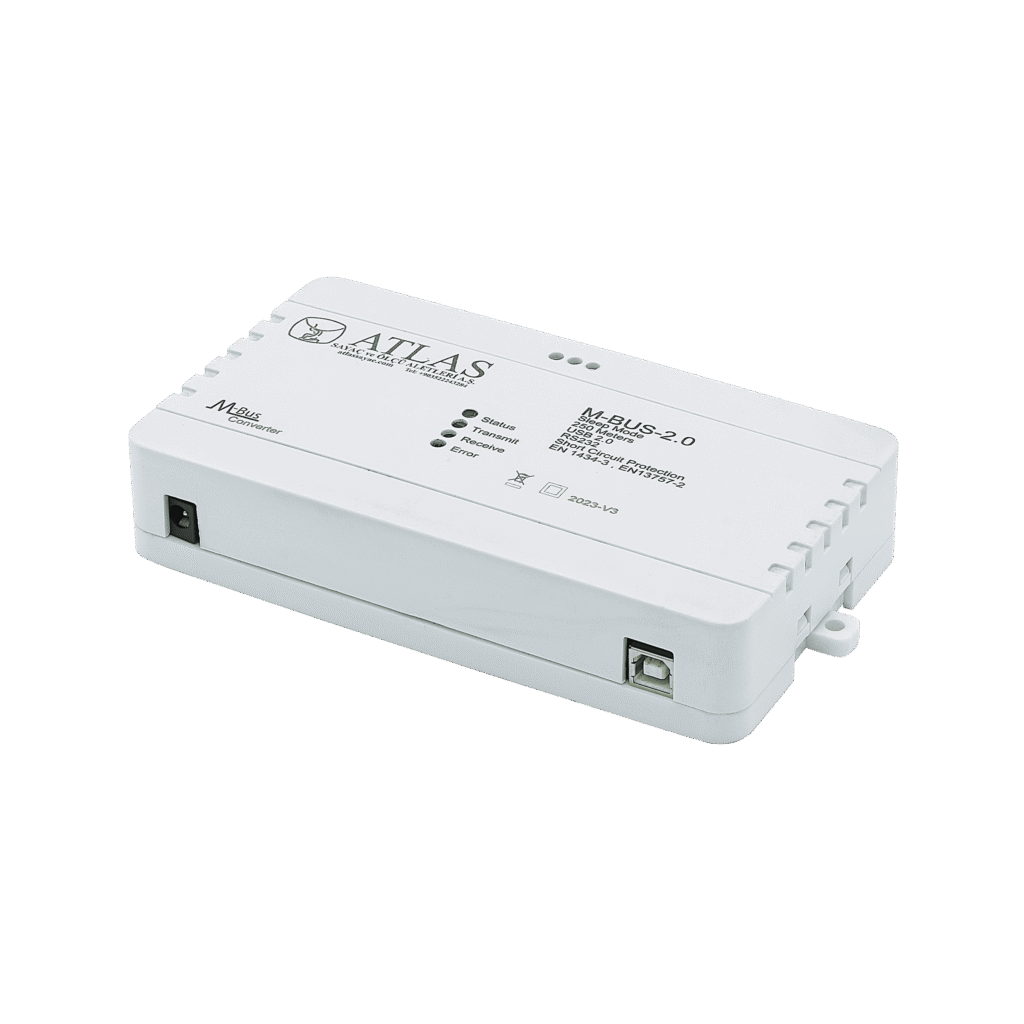
M-Bus reads compatible meters; 4G provides a cellular transport network; MQTT transfers application messages through a broker. The ATLAS M-BUS CONVERTER-4G product specifies an integrated LTE Cat.4 modem and MQTT support. That feature set must not be assumed for every ATLAS converter.
A common chain is meter → M-Bus collector → cellular connection → MQTT broker → validation/storage → analytics or alarm. LoRaWAN, where used, is a different field-radio access layer rather than a synonym for MQTT.
2. What QoS 0, 1 and 2 actually assure
Under the OASIS MQTT 5.0 standard, QoS 0 offers at-most-once delivery, QoS 1 at-least-once delivery, and QoS 2 exactly-once delivery within the specified protocol exchange. QoS 1 may produce duplicates; even QoS 2 does not automatically guarantee one-and-only-one insertion into a downstream business database.
Use an idempotent ingestion key such as device ID plus measured timestamp and a validated reading or event ID. Receiving the same sample twice must not double its reported volume.
3. Keep measurement time distinct from receipt time
Suppose an index was 128.420 m³ at 10:00 and 128.436 m³ at 10:10, but a network outage delayed upload until 10:21. Treating both observations as 10:21 events would distort the profile. Retain measured_at_utc and received_at_utc as separate fields.
A useful message schema includes device_id, measured_at_utc, received_at_utc, register_total_m3, quality_flag and an event key. Clock synchronisation, unit conversion and counter reset or roll-over are explicit validation rules.
4. Worked sizing for interruption buffering
At one record every ten minutes, a meter produces 144 samples per day and 1,008 over seven days. A system serving 100 meters may need to retain 100,800 samples during a comparable interruption, depending on architecture. This is a capacity-planning example, not a statement that any specific ATLAS product has this built-in buffer.
Verify non-volatile memory, record order, retry limits, reconnection rate and deletion after acknowledgement in the manufacturer specification before making contractual commitments.
5. Alarm hysteresis and data quality
A hypothetical high-pressure alarm could activate above 0.50 MPa and clear below 0.45 MPa; three consecutive valid observations might be required. Actual limits depend on the hydraulic asset, risk assessment and sample interval.
Distinguish an offline device, invalid measurement and genuine process excursion. The last stored value must not silently appear as a current reading; expose its age and quality flag.
6. Security and site acceptance
Assess encrypted transport where supported, unique device identities, topic-level ACLs, credential rotation, software update policy and audit logs. NIST IoT guidance covers identification, data protection, logical interface access and secure updates.
Test a timed cellular outage, reconnection, power cycle, repeated message, clock drift and reconciliation against the local meter index. The documented ATLAS 4G configuration includes MQTT QoS/TLS settings, but buffering, backend storage and application alarms require separate verification.
Explore the ATLAS M-BUS CONVERTER-4G approach; provide meter quantity, polling interval, coverage and platform requirements for a technical design. GSM/4G product information · M-Bus Data Collectors.
Buffer and alarm values are engineering examples, not guaranteed product features.
Technical references
OASIS MQTT 5.0 · NIST IoT security guidance · Municipal and Infrastructure Solutions