
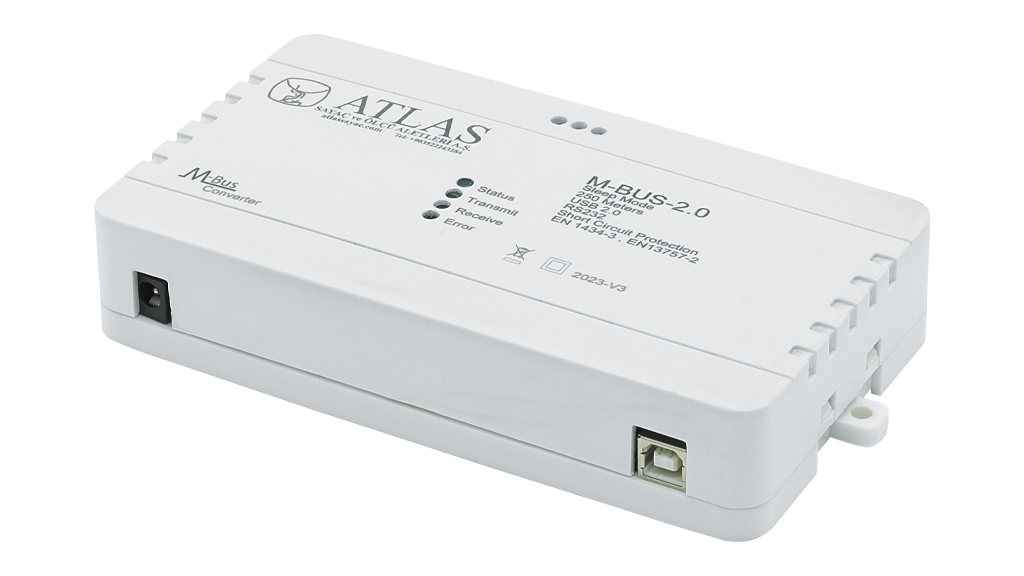
A wired M-Bus trunk can meet its specified electrical unit load and still produce unreliable data. Two devices may share one primary address; secondary identification may be mapped to the wrong customer; or a retry may be treated as a fresh consumption event by the application. This article addresses device identity, request sequencing and idempotent ingestion, not the separate question of maximum cable length or converter loading. ATLAS CNV150/CNV250 converters provide an applicable product context; the numerical examples are engineering scenarios, not product acceptance results.
1. Keep primary addresses distinct from meter and apartment identities
The classic M-Bus link-layer address field is one byte. Ordinary individual primary addresses run from 1 through 250. Address 0 is commonly used for an unconfigured slave; 253 is associated with secondary selection; 254 is a responding broadcast test address; 255 is a broadcast without slave reply; and 251–252 are reserved. These are protocol semantics, not apartment numbers. If two installed meters both answer at primary address 17, their responses can collide, even though total line current is acceptable. Capture the physical serial number and the actual address separately before any permitted reconfiguration.
2. Use secondary selection for discovery, not for guesswork
Where supported, secondary addressing allows the master to select a device by its secondary identification information rather than relying only on its current primary address. Identification may include meter ID, manufacturer, version and medium fields, subject to the protocol implementation. A selection transaction followed by communication at address 253 needs to be visible in the diagnostic log. Do not assume that merely having a serial number guarantees global uniqueness in a mixed fleet, and do not overwrite manufacturer data to make a database import convenient. Maintain a controlled installation inventory linking the physical unit to the customer’s service point.
3. What FCB and FCV actually do
The Frame Count Bit (FCB) and Frame Count Valid (FCV) are link-layer sequencing aids in implementations supporting that mechanism. A repeated response after a retry may be expected behavior, depending on the request and the slave’s state. Neither bit is a unique billing event number, and neither replaces duplicate handling in the cloud database. Distinguish a link-layer request being retried from a new cumulative meter reading. Current standards must govern implementation: EN 13757-2:2018+A1:2023 addresses wired physical/link layers and EN 13757-3:2025 the application protocols. Older M-Bus community documentation is useful background but explicitly non-normative for new designs.
4. Worked example: the same register is not two consumptions
Assume the meter reports 12,400.0 m³ at 10:00, sends the same 12,400.0 m³ at 10:00:03 after a retry, and reports 12,401.5 m³ at 11:00. The period increment is 1.5 m³, subject to valid identity and register continuity. Summing the three cumulative numbers would produce a meaningless 37,201.5 m³; treating the retry as another 12,400.0 m³ delivery is equally wrong. Retain the raw telegram, measured or retrieved timestamp, register identifier and unit. Equality of two readings is not sufficient by itself to classify a duplicate, because real consumption may remain unchanged between different valid measurements.
5. Calculate a lower bound for a polling window
Consider 64 meters, each returning an illustrative 160-byte response, at 2,400 bit/s. If each serial character is represented by 11 transmitted bits including framing, the payload-only response duration is 64×160×11/2400 = 46.9 seconds. This excludes master requests, device latency, turn-around, framing overhead beyond the assumption, retries and any cellular backhaul. A promised complete read cycle must be based on observed telegram sizes and worst-case retry scenarios, not on this lower-bound number. It is distinct from the previous ATLAS article calculating cable load and unit loads.
6. Isolate a collision methodically
First confirm a stable supply, total bus loading and electrical integrity. Query the inventory for duplicate primary assignments and inconsistent physical IDs. Where an actual collision is suspected, segment the bus under an approved isolation procedure, read the devices separately and verify response checksums and addressing. A successful reading on a short isolated branch does not prove the combined network is free of collision. Record the selected secondary address, link reset conditions, transmitted request, raw response and parsed register mapping. Reassigning a primary address must never silently transfer historic consumption from one account to another.
7. Design ingestion to be idempotent and auditable
The durable mapping should be physical meter identity → field bus/connection → service point → timestamped cumulative register. Preserve raw communications alongside normalized units. A genuine repeated delivery should not create a second financial event, while a delayed new measurement should not be discarded merely because it was received during a retry interval. Meter replacement, rollover or reset requires explicit events. Tests should cover collision, duplicate frames, late receipt, unsigned versus signed values, kWh/MWh scaling and the absent-meter case. A missing telegram is not proof of zero consumption.
8. Where ATLAS equipment fits
The ATLAS M-Bus converters identify CNV150 and CNV250 products, but published capacity is not a universal guarantee for every wire network or meter population. A 4G data collector option may be considered where a higher-layer remote connection is required; MQTT handling and M-Bus link behavior remain separate engineering issues. The existing M-Bus cable and unit-load guide covers sizing. This guide covers identity collisions and repeated messages. Include models, meter count, addressing list, bus speed, raw sample frames and the target software in an ATLAS technical request.
Sources verified — 10 November 2026
- EVS EN 13757-2:2018+A1:2023, wired M-Bus physical/link layers.
- EVS EN 13757-3:2025, application protocols. The replacement of the 2018 edition in 2025 was checked; full paid texts were not accessed.
- M-Bus community documentation, link layer and secondary selection. Historical explanatory material, not the current binding specification.
- ATLAS converters and selection guidance.