
Designed for monitoring points without mains power.
ATLAS · Battery-powered LoRaWAN
Fire Hydrant Pressure and Condition Monitoring System
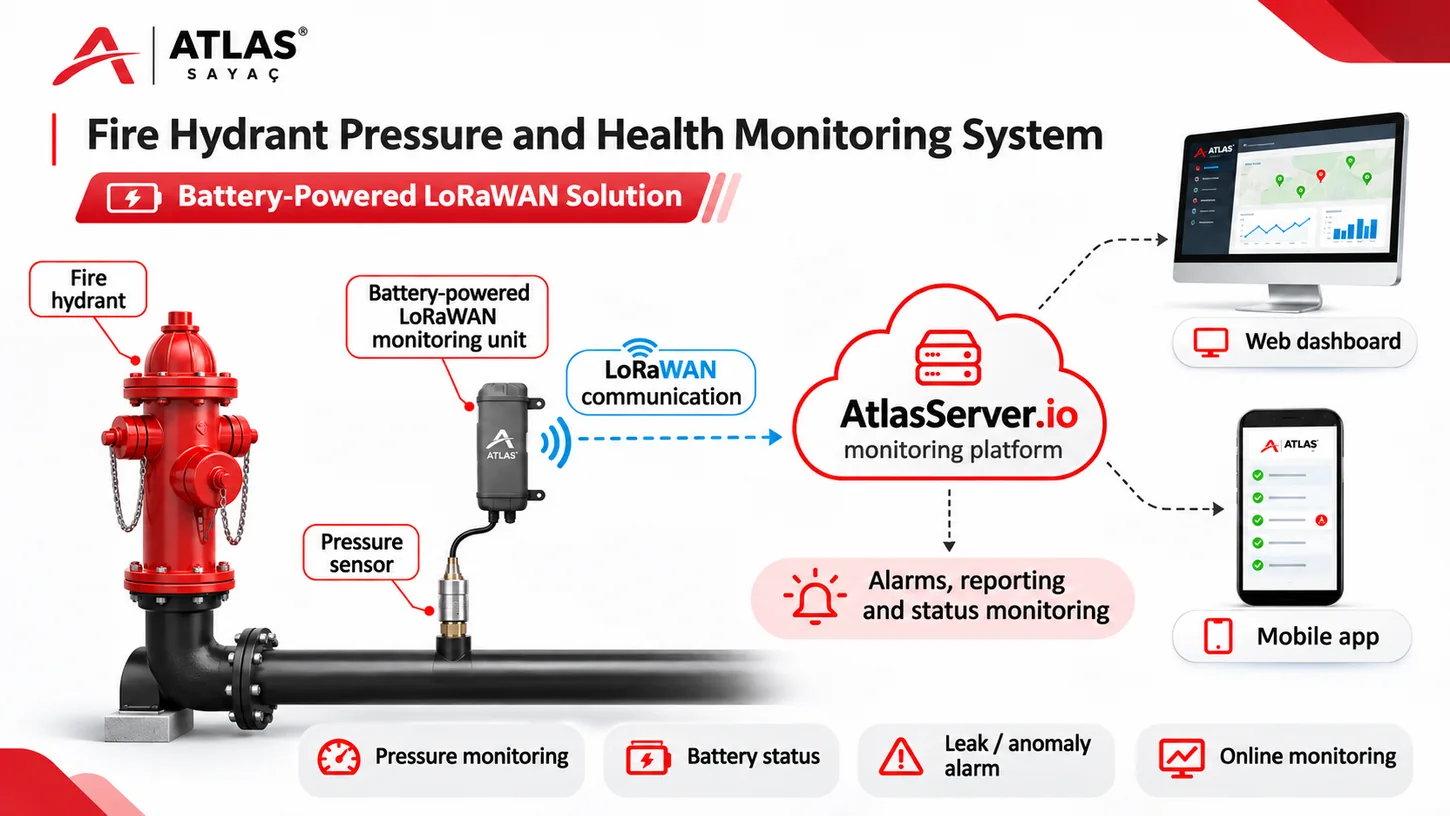
Monitor pressure on fire-hydrant supply lines using battery-operated LoRaWAN field devices and AtlasServer.io. Track pressure trends, last communication, alarms and supported battery indicators in one platform.
Better visibility across hydrant assets
Wide-area field data transfer through a suitable gateway network.
Review pressure variations and long-term trends.
Detect threshold events, missing data and device conditions.
Associate each hydrant with its location and service history.
Web-based monitoring, reporting and controlled user access.
How does the system work?
A pressure transducer is fitted to an appropriate tapping point on the hydrant supply line. A battery-powered ATLAS LoRaWAN node acquires measurements and transmits through a LoRaWAN gateway. IP backhaul delivers packets to the network server, while AtlasServer.io processes and displays the application data.
01Pressure transducer
02Battery LoRaWAN node
03LoRaWAN gateway
04Network server
05AtlasServer.io
Central visibility with AtlasServer.io
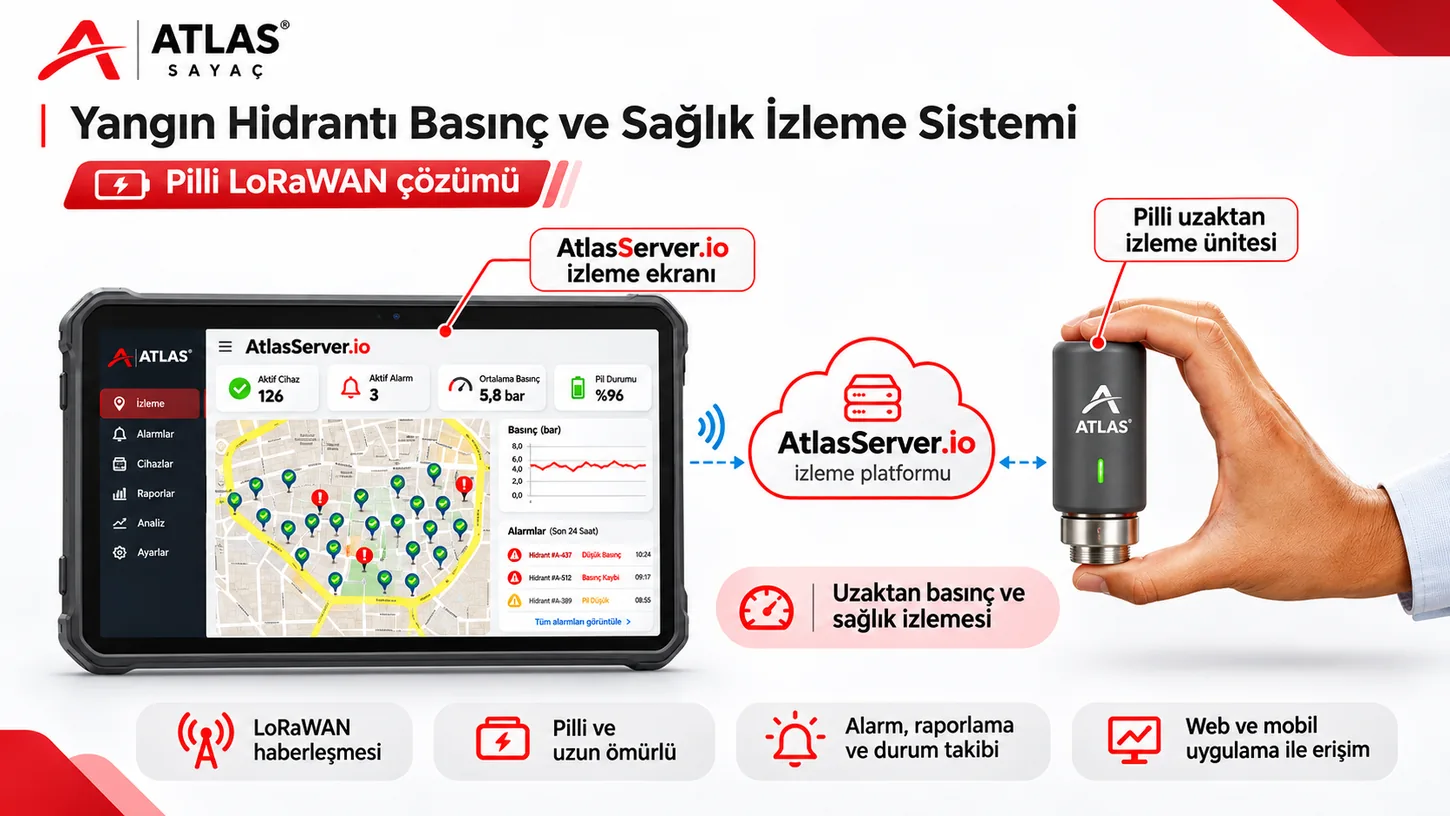
View pressure history, latest uplink, alarms and battery indicators for individual hydrants. Central records can support field inspections and maintenance coordination.
Available monitoring data
Pressure value, timestamp and trend.
Configurable low/high levels or anomalies.
Where supported by the field device.
Last uplink and missing report detection.
Hydrant ID, geographic position and service notes.
Cover, valve or tamper status with additional sensors.
Engineering and deployment
| Power | Battery type, capacity and service life depend on reporting intervals, temperature and radio conditions. |
|---|---|
| Radio network | LoRaWAN regional plan, gateway placement, RF coverage and IP backhaul require a site survey. |
| Pressure sensor | Range, accuracy, fittings and calibration are set by the selected configuration. |
| Platform | AtlasServer.io integrates device records, trends, alerts and user access management. |
| Commissioning | Verify pressure reference, network loss behaviour, battery alarms and threshold events in the field. |
Pressure alone does not establish required fire flow or prove mechanical operation. Hydrants require separate physical inspections and operation/flow testing. Alert latency depends on reporting and RF/network availability.
Where it can be used
Municipal water utilities
Industrial facilities and factories
Campuses, estates and logistics yards
Fire water distribution and hydrant inventories
Frequently asked questions
Does pressure prove a hydrant is ready for use?
No. Flow capacity and mechanical operation require separate testing.
Does the device need a SIM card?
No. LoRaWAN end devices communicate with gateways, which need network backhaul.
What is the battery lifetime?
It is configuration-specific and depends on battery chemistry, reporting intervals, temperature and coverage.
Bring your hydrant assets online
Share hydrant count, pressure range, site locations and network coverage needs for an ATLAS technical proposal.